In the aviation and heavy industrial sectors, a hangar door is not merely a closure; it is a critical architectural component. Tasked with protecting multi-million-dollar aviation assets, these massive moving structures must withstand extreme wind loads, severe climatic conditions, and the rigorous demands of high-frequency operational cycles.
For architects, facility managers, and EPC contractors, specifying the correct hangar door requires a deep understanding of structural clearances, dead-weight distribution, and facility workflows. Below is a comprehensive engineering guide to the 8 primary types of hangar doors, detailing their mechanical features and optimal applications to help you make an informed, project-specific decision.
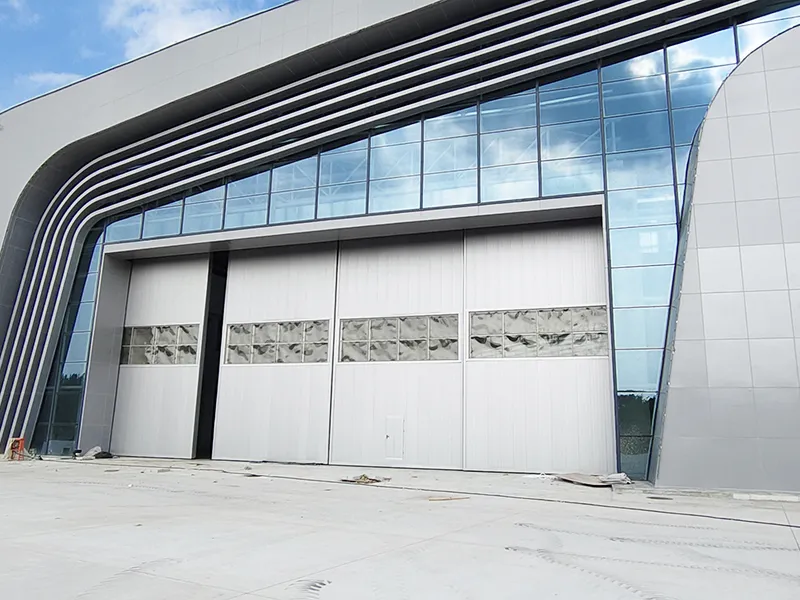
Sliding Hangar Doors (Linear Tracking) Overview Linear sliding hangar doors remain the industry standard for their mechanical reliability and straightforward kinematic design. Consisting of multiple rigid panels that slide horizontally along top-guided and bottom-supported tracks, they provide a highly secure and weather-tight barrier for facilities with adequate lateral side-room.
Engineering Features
Modular Scalability: Fabricated from heavy-duty steel frames, these doors can be infinitely scaled by adding parallel tracks, accommodating anything from single-engine Cessnas to wide-body commercial jets.
Failsafe Operation: Due to their simple horizontal movement, they exert zero vertical lifting strain, allowing for highly reliable motorized operation with manual override capabilities in the event of power loss.
Low Total Cost of Ownership (TCO): With fewer complex moving parts (such as hydraulic rams or lifting cables), sliding mechanisms require minimal preventive maintenance.
Optimal Applications
Fixed Base Operators (FBOs): Highly efficient for regional airports requiring rapid, frequent access.
Corporate Aviation Hangars: Ideal where lateral building space (door pocketing) is not restricted.
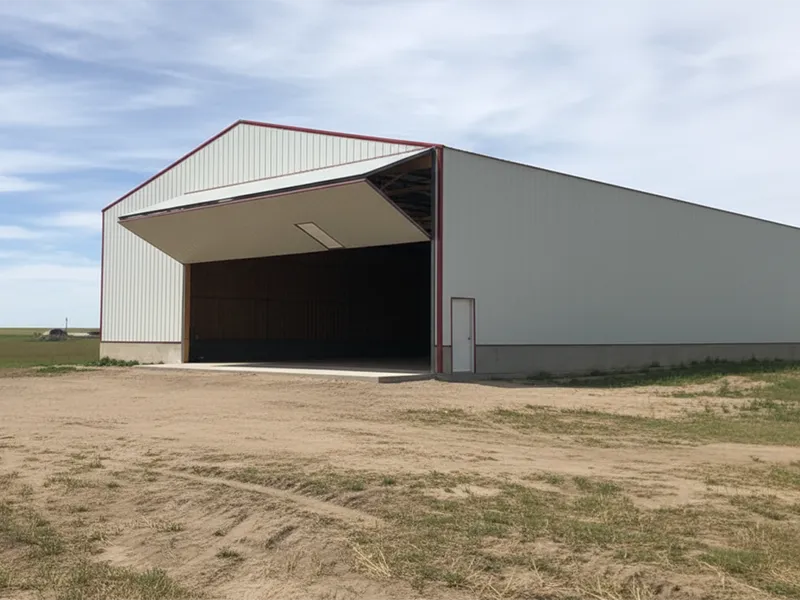
Bi-Fold Hangar Doors (Upward Folding) Overview Designed to fold horizontally in the center and lift vertically, bi-fold hangar doors are the ultimate solution for optimizing structural footprint. Driven by top-mounted motorized winches (cable or strap-lift) or heavy-duty hydraulic cylinders, the door folds outward, transforming into a sturdy exterior canopy.
Engineering Features
Zero Interior Headroom Required: By folding outward, bi-fold doors consume zero interior ceiling space, leaving the overhead area 100% clear for gantry cranes, lighting, and HVAC routing.
Superior Wind-Load Rigidity: Built around a custom-welded steel truss frame, these doors act as a solid structural wall when locked, easily resisting hurricane-force winds.
Architectural Integration: The exterior canopy provides weather protection for personnel and equipment during operations, while the frame can accommodate expansive glass vision panels for natural daylighting.
Optimal Applications
Military & Defense Retrofits: Perfect for upgrading older hangars without altering the existing roof structure.
Agricultural & Heavy Machinery Barns: Ideal for oversized equipment requiring maximum vertical clearance.
Vertical Lift Hangar Doors (Telescoping) Overview When both lateral side-room and exterior projection spaces are restricted, telescoping vertical lift doors offer a genius kinematic solution. These doors consist of multiple horizontal panels that glide straight up, stacking tightly in parallel layers directly behind the building’s header.
Engineering Features
Maximized Site Footprint: By operating entirely within a strict vertical plane, these doors require no side pockets and do not project outward, making them perfect for cramped, high-density airfields.
Heavy-Duty Security: The multi-leaf rigid steel construction provides exceptional physical security and thermal insulation (when clad in PU sandwich panels).
Climate Control: Interlocking panel designs combined with heavy-duty EPDM weather seals offer superior protection against harsh environmental elements.
Optimal Applications
Urban Heliports: Essential for high-density city infrastructure where space is at a premium.
Industrial Manufacturing: Frequently utilized in steel mills and shipyards requiring massive vertical clearance.
Telescopic Hangar Doors (Multi-Track Sliding) Overview A specialized variant of the sliding door, the telescopic hangar door features multiple panels operating on staggered parallel tracks. When opened, the panels slide at synchronized speeds to nest compactly behind one another (or into a wall pocket), creating an extraordinarily wide clear span.
Engineering Features
Massive Clear Openings: Engineered specifically to accommodate the enormous wingspans of wide-body aircraft (e.g., Airbus A380, Boeing 777).
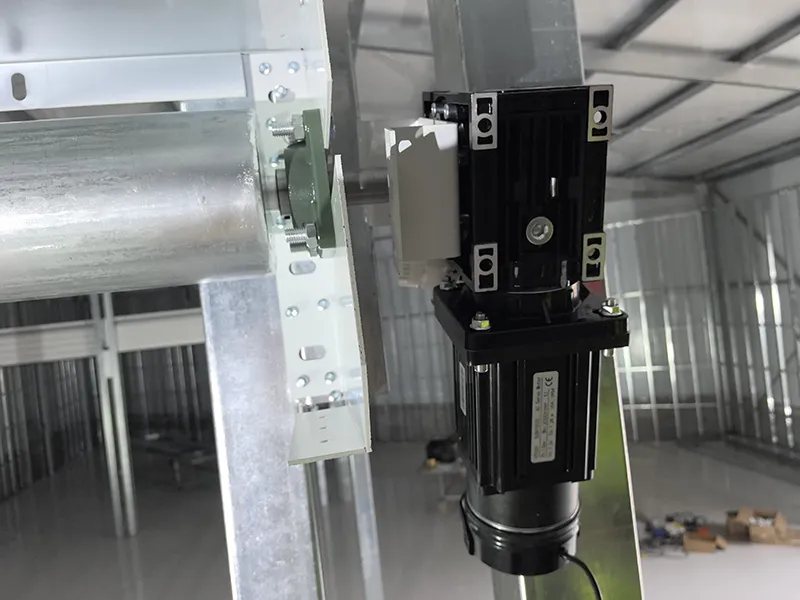
Synchronized Drive Systems: Advanced geared motors ensure all panels move proportionally and arrive at the fully open or closed position simultaneously, reducing operational time.
Architectural Flexibility: Can be configured as uni-directional (sliding to one side) or bi-parting (sliding from the center to both sides), depending on the building’s layout.
Optimal Applications
Commercial Aviation MROs: The standard choice for major Maintenance, Repair, and Overhaul facilities requiring maximum width.
Aerospace Manufacturing: Used in final assembly lines for commercial and military aerospace projects.
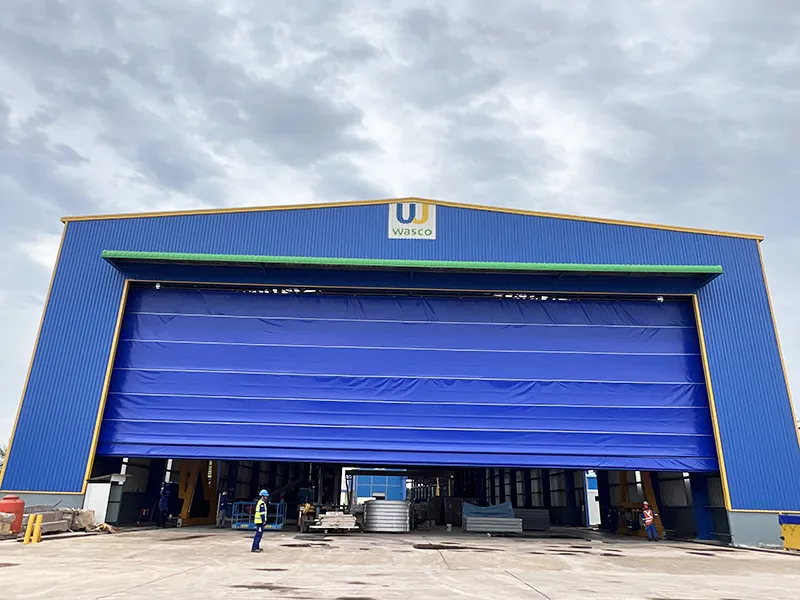
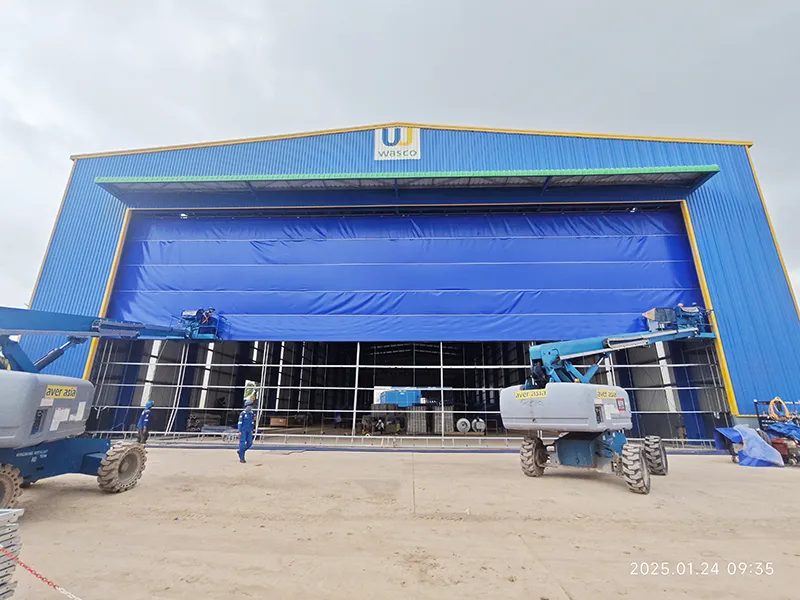
Fabric Hangar Doors (Vertical Lifting Megadoors) Overview When scale reaches extreme limits, rigid steel doors become impractically heavy. Fabric hangar doors (often referred to as Megadoors) utilize a dual-layer, high-tensile PVC-coated polyester fabric curtain interspersed with horizontal aluminum or steel wind trusses, lifting vertically via motorized straps.
Engineering Features
Extreme Wind Resistance: The horizontal wind bars transfer immense hurricane-force kinetic energy directly into the side guide rails, preventing the door from blowing out.
Zero Floor Tracks: Operating entirely from top-mounted hoists, these doors require no fragile bottom floor tracks, ensuring smooth passage for heavy aircraft tugs and eliminating the risk of tracks clogging with ice or debris.
Accommodates Building Deflection: The flexible fabric nature effortlessly absorbs minor building settling or roof deflections without jamming.
Optimal Applications
Extreme Climates: Shipyards and mining facilities subject to highly corrosive salt air or sub-zero arctic temperatures.
Temporary / Expeditionary Hangars: Highly favored by military forces for semi-permanent structures due to their lightweight installation.
Fabric Hangar Doors (Vertical Lifting Megadoors) Overview When scale reaches extreme limits, rigid steel doors become impractically heavy. Fabric hangar doors (often referred to as Megadoors) utilize a dual-layer, high-tensile PVC-coated polyester fabric curtain interspersed with horizontal aluminum or steel wind trusses, lifting vertically via motorized straps.
Engineering Features
Extreme Wind Resistance: The horizontal wind bars transfer immense hurricane-force kinetic energy directly into the side guide rails, preventing the door from blowing out.
Zero Floor Tracks: Operating entirely from top-mounted hoists, these doors require no fragile bottom floor tracks, ensuring smooth passage for heavy aircraft tugs and eliminating the risk of tracks clogging with ice or debris.
Accommodates Building Deflection: The flexible fabric nature effortlessly absorbs minor building settling or roof deflections without jamming.
Optimal Applications
Extreme Climates: Shipyards and mining facilities subject to highly corrosive salt air or sub-zero arctic temperatures.
Temporary / Expeditionary Hangars: Highly favored by military forces for semi-permanent structures due to their lightweight installation.
Bottom Rolling Hangar Doors Overview For doors weighing tens or even hundreds of tons, hanging them from the roof structure is often structurally impossible. Bottom rolling hangar doors solve this by transferring 100% of the door’s dead weight directly to a heavy-duty floor rail, while the top track serves merely as a lateral guide.
Engineering Features
Infinite Load Capacity: Utilizing forged steel crane wheels and self-aligning bearings, this system can support unfathomably large and heavy door structures.
Saves Roof Steel Costs: By eliminating the need for the building’s roof truss to support the door’s weight, contractors can significantly reduce the structural steel costs of the hangar building.
Vibration-Free Movement: Despite their colossal size, the bottom-rolling mechanism guarantees a smooth, quiet, and vibration-free motion.
Optimal Applications
Military Bomber Hangars: Required for oversized military defense installations.
Multi-Bay Aviation Hubs: Ideal for expansive facilities requiring massive, independently movable door sections.
Round-The-Corner Hangar Doors (Side-Sliding Sectional) Overview When a hangar suffers from severe spatial constraints—lacking the side-room for straight sliding doors, the exterior space for swinging doors, and the ceiling height for vertical lift doors—the round-the-corner (RTC) hangar door is the ultimate spatial problem solver.
Engineering Features
Corner-Navigating Track System: Articulated rigid panels seamlessly glide along curved top and bottom tracks, turning a 90-degree corner to stack flat against the interior side walls.
Unobstructed Openings: Eliminates the need for exterior projection or deep wall pockets, maximizing both the driveway clearance and the interior workspace.
Wicket Door Integration: Can be easily fitted with integrated pedestrian pass doors, allowing staff access without cycling the entire massive structure.
Optimal Applications
Tight Airfield Plots: Ideal for small to medium hangars built on highly restricted, densely packed airfield lots.
Irregular Architecture: Perfect for specialized industrial plants or historic hangar retrofits where standard door types cannot be installed.
Conclusion: Partnering for Precision Access Solutions Specifying the correct hangar door is a critical decision that dictates the safety, workflow efficiency, and structural integrity of your aviation facility. Whether your project prioritizes massive clear spans, hurricane-proof wind resistance, or zero-headroom architectural integration, understanding the engineering capabilities of each door type is paramount.
Do not compromise on your facility’s most critical barrier.
At YUOU® , we specialize in the custom engineering, manufacturing, and global deployment of heavy-duty hangar doors. If you are an architect, EPC contractor, or MRO facility manager navigating complex opening requirements, [Contact Our Engineering Team Today] . We will provide comprehensive structural consultations, precise CAD drawings, and bespoke door solutions tailored exactly to your project’s specifications.