In the aviation, aerospace, and heavy industrial sectors, a hangar door is far more than a simple closure—it is a highly engineered architectural barrier. Tasked with safeguarding multi-million-dollar aviation assets, from private jets to wide-body commercial airliners, these colossal moving structures must seamlessly balance structural integrity, operational efficiency, and uncompromising safety.
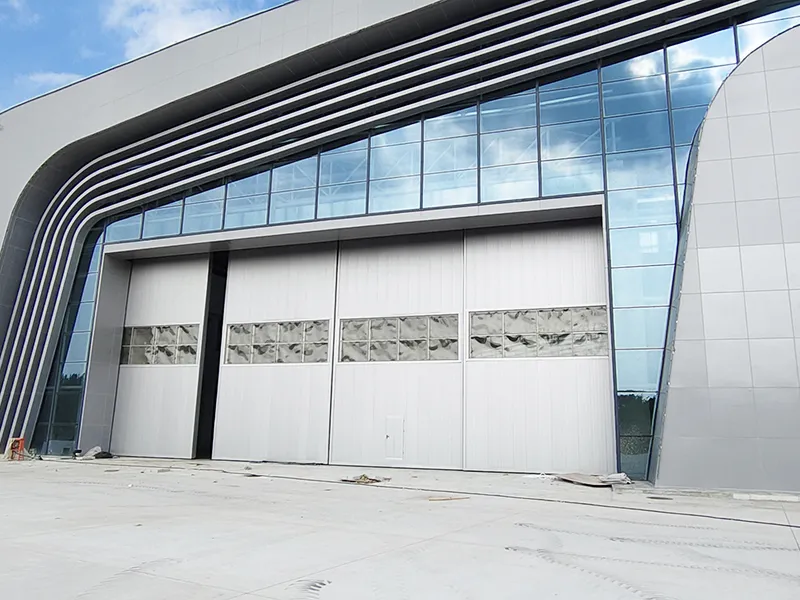
What Is A Sliding Hangar Door? Sliding hangar doors are massive, horizontally moving multi-panel systems designed specifically for aircraft hangars, shipyards, and large-scale manufacturing facilities. Unlike traditional swing doors that consume vast amounts of exterior apron space or overhead doors that interfere with ceiling infrastructure, sliding doors glide efficiently along engineered track systems. This horizontal kinematic design makes them the ultimate solution for facilities requiring extraordinarily wide clear spans and robust resistance to harsh climatic conditions.
Key Engineering Features of Sliding Hangar Doors Structural Durability and Wind-Load Resistance Aviation facilities are frequently located in exposed, high-wind environments such as coastal airports. Premium sliding hangar doors are fabricated around custom-welded, heavy-gauge steel truss frames. Clad in high-tensile steel sheets or insulated polyurethane (PU) sandwich panels, this robust construction is mathematically engineered to withstand extreme dynamic wind loads—including hurricane and typhoon-force winds—preventing catastrophic panel deflection or blowout.
Infinite Scalability for Massive Openings The primary architectural advantage of sliding hangar doors is their ability to accommodate virtually unlimited clear spans. By adding continuous floor tracks and synchronized door panels, these systems simplify the intricate maneuvering of wide-body aircraft (e.g., Airbus A380, Boeing 777), ground support equipment (GSE), and heavy tow tractors.
Deep Customization & Climate Control Tailored sliding doors can be engineered to meet precise facility specifications. Beyond custom sizing and specific RAL powder-coated finishes, they can be heavily insulated. Integrating heavy-duty EPDM sweep gaskets at the bottom and specialized labyrinth interlocking weather seals between panels creates a formidable, watertight, and draft-free barrier, drastically reducing HVAC energy costs. Furthermore, pedestrian wicket doors (pass doors) can be integrated, allowing staff access without cycling the entire colossal structure.
Intelligent Failsafe Safety Features Moving steel panels weighing tens or hundreds of tons requires immense, controlled power. Modern sliding hangar doors are driven by industrial-grade geared motors integrated with Variable Frequency Drives (VFD) for mathematically smooth soft-start and soft-stop operations. They feature comprehensive safety suites, including infrared photoelectric sensors, continuous safety leading edges, and emergency dynamic braking to prevent collisions with personnel or aircraft wings.
Strategic Benefits of Sliding Hangar Doors Ultimate Space Efficiency (Zero Apron Interference) Since sliding hangar doors operate strictly along a horizontal plane parallel to the building facade, they require absolutely no outward swinging space. This ensures the exterior concrete apron remains 100% clear for aircraft taxiing and parking, maximizing the operational footprint of densely packed airfields.
High-Cycle Motorized Efficiency Automated sliding hangar doors are designed to eliminate logistical bottlenecks. Operated via a centralized push-button control station or remote access, these heavy-duty drive systems reduce manual labor to zero. Advanced PLC controllers can even be synchronized to open multiple panels simultaneously, drastically reducing the time the hangar interior is exposed to outside temperatures.
Enhanced Asset Protection & Security When fully closed and secured, the interlocking steel panels form an impenetrable structural wall. The heavy-duty motorized locking mechanisms prevent unauthorized access, providing the highest tier of physical security for classified military aircraft, commercial fleets, and sensitive MRO equipment.
Primary Types of Sliding Hangar Door Configurations Selecting the correct kinematic configuration depends entirely on the building’s architectural layout, available pocket space, and structural load-bearing capacity.
Uni-Directional (Single/Multi-Panel) Sliding Doors In this configuration, one or multiple panels glide horizontally in a single direction, stacking into a wall pocket on one side of the hangar. Highly cost-effective and mechanically straightforward, this design is perfect for smaller Fixed Base Operator (FBO) hangars or facilities where lateral space is only available on one side of the opening.
Bi-Parting Sliding Doors For larger openings, bi-parting doors are the industry standard. They consist of two (or multiple) sets of panels that meet in the center of the opening and slide in opposite directions. This configuration offers significantly faster opening speeds than uni-directional doors and ensures a balanced distribution of dead weight and wind load across the building’s facade.
Telescopic Sliding Doors (Multi-Track System) When an extraordinarily wide clear span is required but lateral wall space (pocket depth) is highly restricted, telescopic sliding doors are the ultimate solution. Operating on staggered parallel tracks, the panels slide at synchronized, proportional speeds to nest compactly behind one another. This telescoping effect maximizes the drive-through width while minimizing the door’s storage footprint.
Bottom-Rolling vs. Top-Hung Systems Bottom-Rolling Sliding Doors: The absolute standard for massive commercial hangars. The entire dead weight of the multi-ton door rests on forged steel crane wheels that run along heavy-duty floor rails. The top track serves merely as a lateral guide, significantly reducing the structural steel costs of the hangar roof.
Top-Hung Sliding Doors: Here, heavy-duty carriage rollers suspend the door entirely from an overhead structural beam. Eliminating floor tracks guarantees seamless functionality for facilities with uneven flooring or where ground tracks would impede delicate machinery. Note: This requires a massively reinforced roof truss to support the door’s dead weight.
Engineering & Installation Best Practices Installing a sliding hangar door is a major construction milestone that requires absolute precision and collaboration between the door manufacturer and the general contractor (EPC).
Precision Track Alignment and Foundation Engineering The foundation is the lifeblood of a bottom-rolling door. Achieving millimeter-precise laser alignment and leveling of the floor tracks embedded in the concrete threshold is paramount. Any concrete settling or track misalignment will cause the massive steel wheels to bind, resulting in severe motor strain and eventual operational failure.
Structural Header and Wind-Load Calculations Before installation, structural engineers must verify that the building’s header (top beam) can withstand the lateral forces transferred by the door during a severe wind event. For top-hung systems, the roof must be extensively reinforced to carry the immense static load without sagging over time.
Integrate Smart Safety & BMS Systems Incorporating obstruction detection systems and emergency stops is a strict aviation safety requirement. Professional installers must meticulously wire the VFD control panel, ensuring seamless integration with the facility’s centralized Building Management System (BMS) for automated, failsafe operation.
Rigorous Preventive Maintenance To guarantee longevity, a strict maintenance protocol is required. Facility managers must routinely inspect the track system for debris, monitor the VFD parameters, and lubricate the forged steel rollers and top-guide bearings to prevent friction-induced wear and tear.
Partner with Professional OEM Installers Given the colossal scale, electrical complexity, and extreme safety requirements of sliding hangar doors, DIY or third-party installation is highly discouraged. Partnering directly with the original equipment manufacturer (OEM) or certified professional installers ensures the doors are mounted flawlessly, with all safety features and operational kinematics functioning exactly as engineered.
Conclusion: Securing Your Aviation Assets Specifying the correct sliding hangar door dictates the long-term safety, workflow efficiency, and structural resilience of your aviation facility. Whether your project prioritizes massive clear spans for commercial jets, space-saving telescopic kinematics, or heavy-duty bottom-rolling tracks, precise engineering is non-negotiable. By understanding the varying configurations, critical features, and strict installation protocols, architects and facility managers can ensure the successful deployment of these monumental doors.
Don’t compromise on your facility’s most critical barrier. At YUOU® , we specialize in the custom engineering, manufacturing, and global deployment of heavy-duty sliding hangar doors. If you are navigating complex opening requirements, contact our engineering experts today for bespoke CAD drawings, wind-load data, and project-specific pricing.